
The world's best ACO’s trust Astrello.


what we do
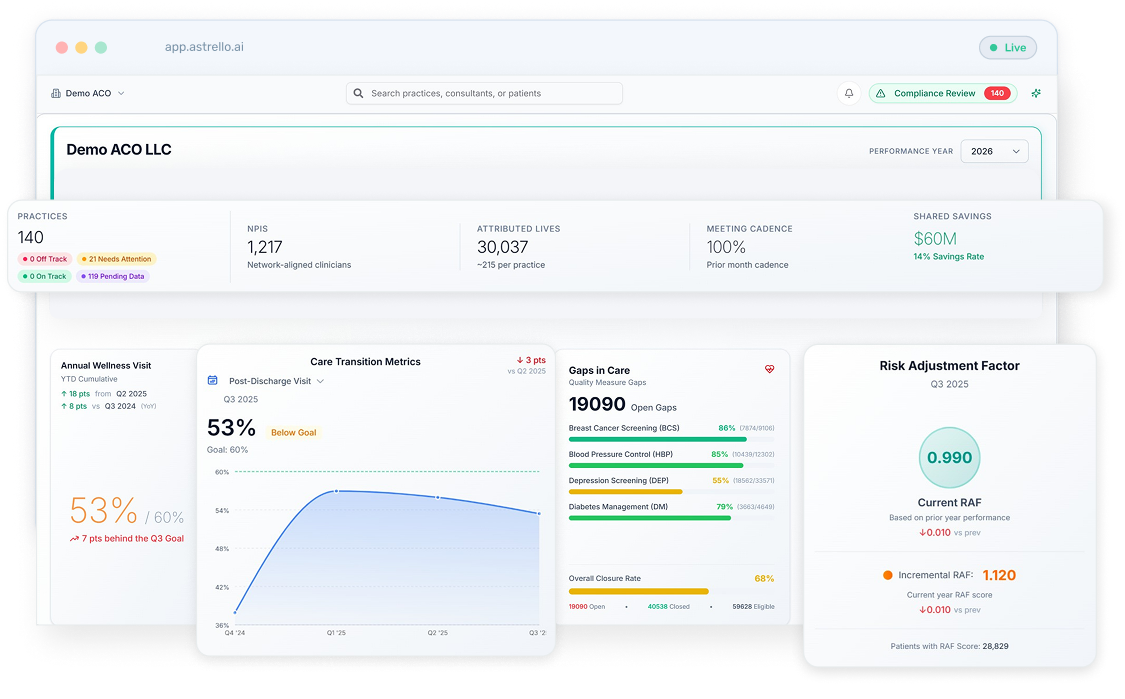
The full technology stack for modern ACOs
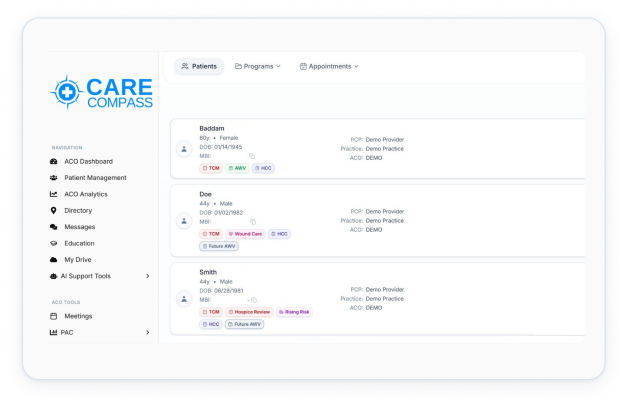
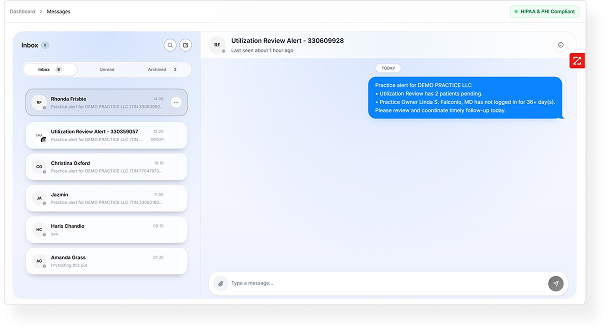
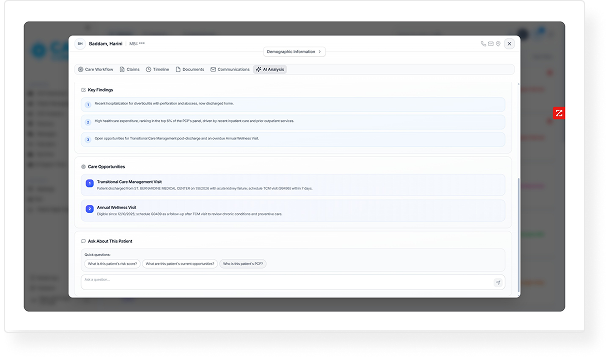
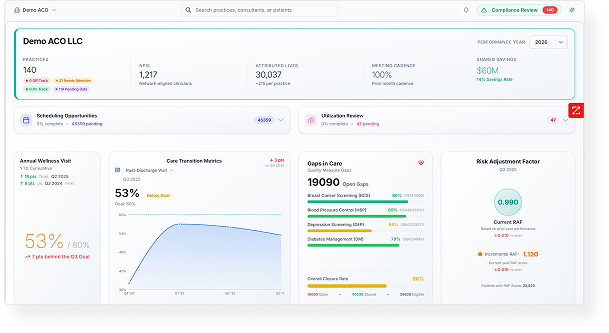
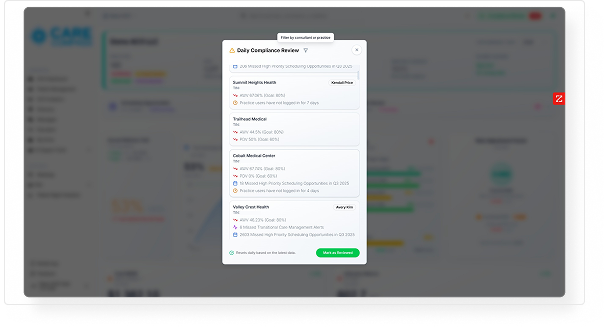
From real-time patient admission alerts to automated quality submissions, Astrello brings every function of a high-performing organization into a single, connected platform.
HOW IT WORKS
From enrollment to shared savings — simplified
Astrello streamlines every stage of participation, so your physicians can focus on patients instead of paperwork.
Connect Your Network
Onboard physicians, hospitals, and care partners with guided setup. We integrate with major EHR systems and hospital feeds on day one.
Activate Data Feeds
Real-time ADT alerts, patient risk scores, and care gap reports begin flowing automatically across your entire network.
Coordinate & Intervene
Physicians receive actionable alerts and reports. Care coordinators close gaps and schedule follow-ups before costs escalate.
Earn Shared Savings
Quality submissions go out automatically. Your ACO meets CMS benchmarks and shared savings flow back to the physicians who drove them.
$25K
Avg. savings per patient from prevented ER admissions
5,000+
Participating network providers supported
26
States with active ACO network coverage
~15%
Industry-low overhead maximizing physician returns
PLATFORM PILLARS
Everything your organization needs to thrive
Four integrated pillars that work together to improve outcomes, reduce costs, and keep physicians in control of their practices.

Care Coordination Hub
A unified command center for managing transitions of care, tracking high-risk patients, and ensuring no patient falls through the cracks after a hospitalization or specialist visit.
- Hospital admission & discharge alerts
- SNF, home health, and ED event tracking
- Care team task management & follow-up workflows
- +1 more
Quality & Compliance Engine
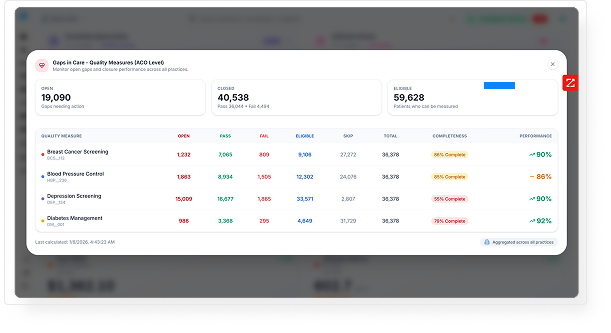
Automated care gap identification, measure tracking, and CMS quality submission built to keep your ACO compliant and performing at the top of national benchmarks.
- HEDIS & CMS quality measure tracking
- Automated gap closure workflows
- MIPS & ACO REACH reporting
- +1 more

Physician Intelligence Layer
Give every physician in your network actionable, personalized data reports — not generic dashboards. Risk-stratified patient lists, utilization benchmarks, and peer performance insights.
- Individual physician performance reports
- Risk-stratified patient rosters
- Chronic disease management tracking
- +1 more

Network & Payer Connectivity
Broad connectivity across Medicare, Medicare Advantage, commercial, and exchange payers. Manage multi-payer contracts and preferred referral networks from a single platform.
- Medicare MSSP & ACO REACH contracts
- Medicare Advantage value-based contracts
- Commercial & exchange payer integration
- +1 more
WHO WE SERVE
The right fit for every type of value-based organization
MSSP ACOs
Medicare Shared Savings Program Participants
Maximize your shared savings distribution with real-time quality tracking, automated CMS submissions, and risk-adjusted patient management across your entire attributed population. We've helped ACO partners achieve top national performance rankings five out of nine consecutive years.
Top national ranking
5 of 9 consecutive years
Independent Physicians
Independent Primary Care Practices
Stay independent without falling behind. Astrello gives solo and small-group PCPs the same data infrastructure, population health tools, and payer access that large health systems take for granted — at a fraction of the cost, with physician equity and ownership built in.
~15% overhead
Industry-lowest rate
aco reach
Direct Contracting & REACH Entities
Navigate the complexity of ACO REACH with purpose-built compliance tools, full-risk patient management capabilities, and a data infrastructure designed for the rigorous reporting requirements of direct contracting with CMS. Operate with confidence in an evolving regulatory environment.
26 states
Active network coverage
PHYSICIAN VOICES
What happens when the right tools meet great physicians
★★★★★
"
"The real-time ADT alerts completely changed how we handle hospital transitions. We're catching patients at discharge now instead of finding out weeks later when they're readmitted. Our readmission rate dropped significantly in the first quarter alone."
Dr. M. Rodriguez
Internal Medicine · Miami, FL
★★★★★
"
"I joined because of the ACO network, but I stayed because of the platform. The quality reporting used to take my staff hours every week. Now it's automated. I can actually focus on my patients instead of chasing paperwork and CMS deadlines."
Dr. K. Patel
Family Medicine · Boca Raton, FL
★★★★★
"
"What impressed me most was the data. My consultant showed me patients who had been receiving home health services for two years that I wasn't adequately tracking. That level of visibility is what separates a high-performing ACO from an average one."
Dr. I. Braverman
Geriatric Medicine · West Palm Beach, FL

Got an idea?
Missing a feature that would transform your ACO's workflow?
Submit it here and let the community vote.